 English



Views: 0 Author: Site Editor Publish Time: 28-01-2026 Origin: Site


Casting Method | Tooling Cost | Dimensional Tolerance | Surface Finish (Ra) |
|---|---|---|---|
Permanent Mold Casting | $20,000 – 50,000 | ± 0.25 – 1.0 mm | 1.6 – 6.3 µm |
Investment Casting | $15,000 – 50,000+ | ± 0.05 – 0.25 mm | 0.8 – 3.2 µm |
Use investment casting for complex parts and fine details.
Choose permanent mold casting for large volumes and lower costs.
Focus on design flexibility, surface finish, cost, and efficiency when you compare methods.
The investment casting process suits low to medium production runs.
Investment casting is ideal for complex parts with fine details, offering high precision and smooth surfaces.
Permanent mold casting is best for high-volume production of simpler parts, providing cost savings and consistent quality.
Consider design flexibility, surface finish, and production volume when choosing between casting methods.
Investment casting supports a wide range of materials, while permanent mold casting is limited to non-ferrous alloys.
Evaluate your project needs, budget, and production goals to select the most suitable casting method.
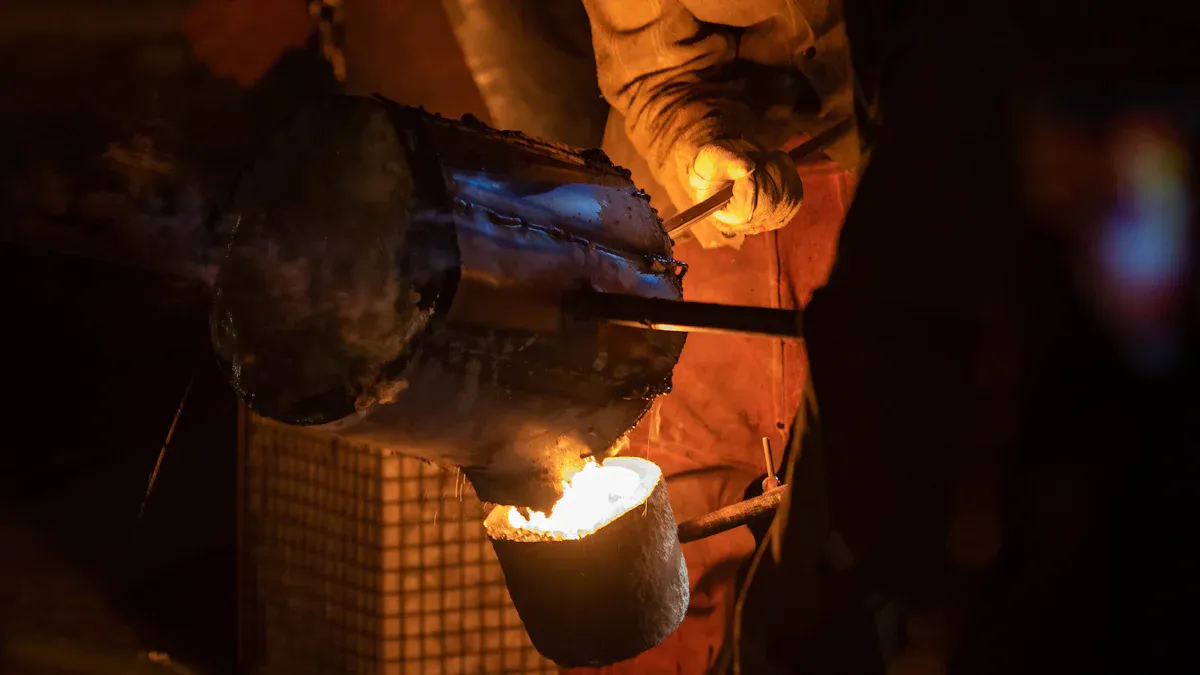
You can use the investment casting process when you need to create parts with high accuracy and fine detail. Many people also call this method lost wax casting. The investment casting process uses a series of steps to make sure you get precise and reliable results. Here is how the casting process works:
Create and Assemble the Wax Patterns: You start by making wax patterns. You can use hand carving or 3D printing for this step. This step sets the shape and detail for your final part.
Mount the Wax Patterns: You attach the wax patterns to a feeder structure. This helps the metal flow into every part of the mold during the casting process.
Make a Mold Shell: You dip the wax assembly into a ceramic slurry. This creates a strong and accurate mold shell around your pattern.
Remove the Wax: You heat the mold to melt and drain out the wax. This leaves a hollow ceramic shell ready for metal.
Melt and Cast the Metal: You pour molten metal into the preheated mold. Careful pouring helps you get a smooth surface and strong structure.
Finalize the Castings: You break away the ceramic shell and finish the part. You may grind, polish, or machine the casting to meet your needs.
The investment casting process gives you excellent control over shape and surface finish. You can use it to make intricate metal pieces that other methods cannot match.
You will find that investment casting offers many strengths. This precision casting method lets you create complex shapes with tight tolerances and smooth surfaces. You can use the investment casting process for both small and medium production runs.
Tip: Choose investment casting when you need fine details, thin walls, or a high-quality finish.
Here is a table showing where you often see investment casting used:
Industry | Typical Applications |
|---|---|
Aerospace | Thin-walled components, smooth surfaces, parts with minimal draft for weight savings |
Medical and Surgical Equipment | Implants, prosthetics, surgical clips, clamps, handles |
Biotech and Life Sciences | Lab equipment, analytical tools, microfluidic parts |
Robotics and Electromechanical | Actuator housings, transmission parts |
Semiconductor Equipment | Chamber parts, vacuum seals, nozzles |
High-Tech Telecom Systems | Antenna housings, connectors, GPS navigation parts |
You can rely on investment casting for parts that need high precision and a great finish. The investment casting process works well for aerospace, medical, and high-tech industries. You can also use it for jewelry, art, and other fields that need intricate metal pieces. This casting process gives you flexibility and quality that many other casting methods cannot provide.
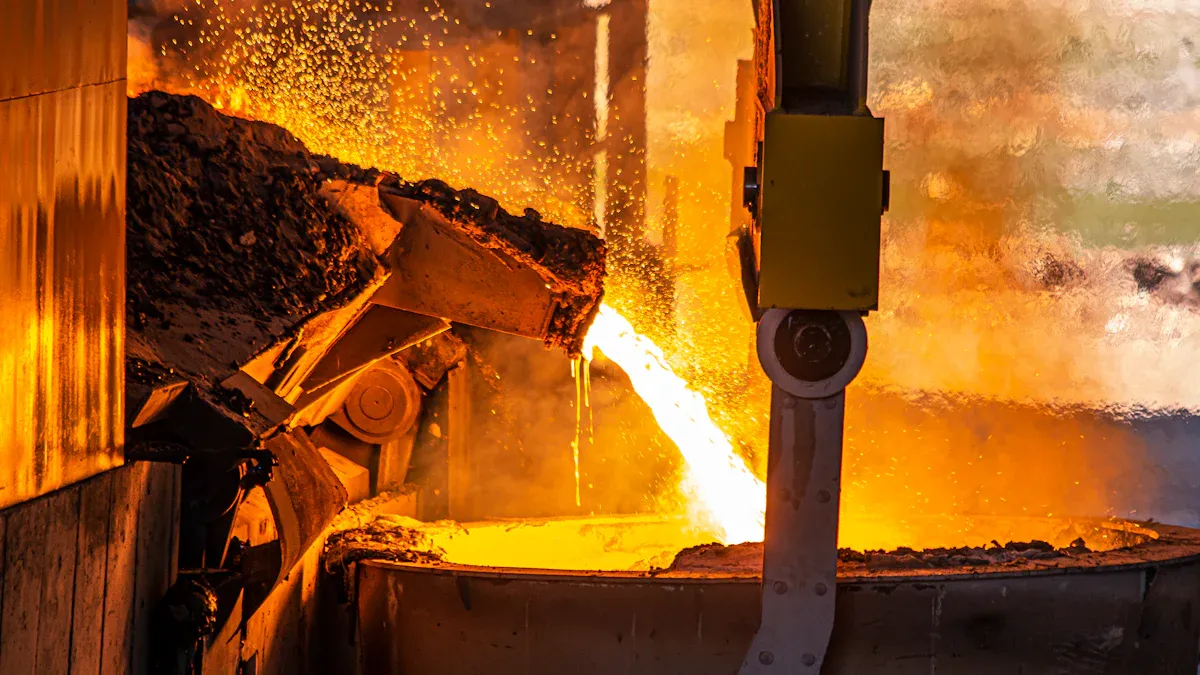
Permanent mold casting uses reusable molds made from strong metals. You can rely on this method for consistent results and efficient production. Here are the main steps you follow in the casting process:
Mold Design and Preparation: You design the mold to allow easy removal of the casting. The mold is made from steel or iron. You preheat and coat the mold to prevent sticking and control cooling.
Melting and Pouring: You melt the metal alloy and pour it into the mold. Careful pouring helps you avoid defects and ensures the mold fills completely.
Solidification and Cooling: The metal cools quickly inside the metallic mold. Fast cooling increases the strength and durability of the casting.
Casting Removal and Finishing: You open the mold and remove the casting. You trim excess material and finish the surface as needed. The mold is cleaned and recoated for the next cycle.
You benefit from high production efficiency with permanent mold casting. Once you prepare the mold, you can produce many identical parts quickly. This method works well for long production runs and helps you lower the cost per part.
Tip: Permanent mold casting is ideal when you need a fast casting cycle and consistent quality for each part.
Permanent mold casting offers several strengths. You get strong, durable castings with good dimensional stability. The process supports medium to high production volumes. You can use this method for parts that need reliable strength and repeatable quality.
Here is a table showing where you often see permanent mold casting used:
Industry | Common Applications |
|---|---|
Automotive | Engine blocks, cylinder heads, transmission cases, structural components |
Aerospace | Components requiring high strength and dimensional stability |
Industrial Machinery | Parts used in machinery and equipment manufacturing |
Electrical and Electronics | Components for electrical devices and systems |
Consumer Goods | Durable and lightweight parts for various products |
You can choose permanent mold casting for automotive, aerospace, and industrial machinery parts. This casting process also works for electrical components and consumer goods. You get reliable results and high output, making it a popular choice for manufacturers who need large quantities of castings.
When you compare casting methods, design flexibility stands out as a key difference. Investment casting gives you the freedom to create intricate shapes and fine details. You can achieve tight tolerances and complex geometries that other methods cannot match. This flexibility makes investment casting ideal for parts with undercuts, thin walls, or internal cavities.
Investment casting allows for intricate designs and tight tolerances, especially for smaller production runs.
Permanent mold casting limits your options for complex shapes because the rigid molds require draft angles and simple parting lines.
You may need expensive solutions if you want to add complexity to permanent mold casting.
Casting Method | Geometric Complexity |
|---|---|
Investment Casting | Excels at producing intricate shapes, deep undercuts, and internal cavities. |
Permanent Mold Casting | Limited by the need for draft angles (1–3°) and simple parting lines; complex features require expensive solutions. |
If your project demands maximum design freedom, investment casting is the better choice.
Precision is crucial when you need parts to fit together perfectly or perform under strict conditions. Investment casting delivers exceptional precision, often achieving tolerances as tight as ±0.1 mm. This level of accuracy makes it suitable for aerospace, automotive, and medical applications where every millimeter counts.
Permanent mold casting also provides good dimensional accuracy, especially for high-volume production. You can expect consistent results, but the tolerances are not as tight as those from investment casting.
Casting Method | Dimensional Accuracy | Tolerances | Ideal Use Cases |
|---|---|---|---|
Investment Casting | Exceptional | ±0.1 mm | Aerospace, automotive, medical |
Permanent Mold Casting | Consistent | Not specified | High-volume production, cost-effective |
You should choose investment casting when you need the highest precision. Permanent mold casting works well for projects where consistency and cost matter more than ultra-tight tolerances.
Surface finish affects both the appearance and performance of your castings. Investment casting stands out for its smooth surface finish, often reaching Ra values between 1.6 and 3.2 micrometers. This smoothness means you spend less time and money on post-processing steps like grinding or polishing.
Permanent mold casting can also produce good surface finishes, but it usually cannot match the high-quality surface finishes of investment casting. You may need extra finishing work if you want a mirror-like appearance.
Casting Method | Typical As-Cast Ra (μm) | Typical As-Cast Ra (μin) |
|---|---|---|
Investment Casting | 1.6 – 3.2 | 63 – 125 |
Permanent Mold Casting | 3.2 – 6.3 | 125 – 250 |
Note: Investment casting generally delivers a significantly smoother surface right from the start, which can drastically cut down on secondary finishing steps, saving time and money.
If your part requires a smooth surface finish and minimal post-processing, investment casting is the preferred method.
You need to consider which materials work best with each casting process. Investment casting supports a broad range of metals, including steel, stainless steel, aluminum, titanium, and more. This versatility lets you tailor the mechanical properties of your parts to meet specific performance criteria.
Permanent mold casting works mainly with non-ferrous alloys such as aluminum, magnesium, and copper. The process uses durable molds, which provide repeatable castings with consistent properties. However, you face limitations if you want to use ferrous metals or create very large parts.
Casting Method | Material Compatibility | Limitations |
|---|---|---|
Investment Casting | Broad material compatibility | High cost, complex process, not suitable for very large parts |
Permanent Mold Casting | Mainly non-ferrous alloys | High mold cost, strict process control, limited to medium complexity |
Investment casting offers more versatility in material selection, while permanent mold casting focuses on efficiency with specific alloys.
Cost and efficiency often drive your decision between casting methods. Investment casting usually costs more per part, especially for complex shapes or small production runs. For example, a simple stainless steel part of 1 cubic inch may cost $200 to $400 per piece, while a more complex part could reach $500 to $800. As production volume increases, the cost per unit drops, but investment casting remains best for low to medium volumes.
Permanent mold casting shines in high-volume production. Once you invest in the mold, you can produce thousands of parts quickly and at a lower cost per unit. This method also reduces material waste, making it more economical for large batches.
Tip: Choose permanent mold casting when you need high output and cost savings for simpler parts.
You will see investment casting and permanent mold casting used in different industries based on their strengths.
Casting Method | Common Applications | Industry Sector |
|---|---|---|
Investment Casting | Complex designs, intricate parts | Aerospace, Medical |
Permanent Mold Casting | High volume production, clean finishes | Automotive, Consumer Goods |
Investment casting is favored for applications that demand high precision and complex geometries, such as aerospace and medical components. These parts often need to endure extreme conditions and require top quality. Permanent mold casting is more suitable for simpler shapes and lower precision needs, focusing on cost and production speed. You will find it used in automotive, industrial machinery, and consumer goods where strength, durability, and efficiency matter most.
By understanding these differences, you can select the casting method that best matches your project’s requirements for precision, quality, and efficiency.
When you consider investment casting, you find several advantages that make this process stand out. You can create complex shapes and intricate features with this method. The design flexibility allows you to produce parts that other methods cannot handle. You also get high-quality properties, such as smooth surfaces and tight tolerances. These benefits help you reduce the need for extra finishing work.
You can use a wide range of materials, including aluminum alloys and non-ferrous metals.
The process achieves near net shape components, which means you often need little or no post-processing.
Investment casting works well for small production runs, sometimes as few as ten pieces, without high costs.
However, you should also consider the drawbacks. Investment casting can be time-consuming because it requires detailed pattern-making and several manual steps. The production costs are higher, especially for large or heavy parts. There are also size limitations, so you may not be able to use this method for very large castings.
Note: Investment casting gives you excellent results for complex parts, but you need to plan for longer lead times and higher costs.
Permanent mold casting offers its own set of benefits. You get strong, less porous parts with good dimensional accuracy. The molds last for many cycles, making this method ideal for high-volume production. You also benefit from a superior surface finish compared to sand casting, and you can control the texture of your parts.
The process provides rapid solidification, which improves the mechanical properties of your castings.
You can achieve consistent quality and quick cycle times, which lowers the cost per part in large batches.
Permanent mold casting is suitable for moderate to high production volumes.
On the other hand, you face some disadvantages. The initial cost for creating permanent molds is high. This method is not cost-effective for low-volume production. You also have size and alloy limitations, as the process works best with non-ferrous metals and medium-sized parts. Sometimes, you need to remove parting lines by machining or polishing.
Tip: Choose permanent mold casting when you need strong, consistent parts and plan to produce them in large quantities.
By understanding the pros and cons of each casting method, you can match the right process to your project and maximize the benefits for your application.
When you choose between investment casting and permanent mold casting, you need to look at several important factors. Each method offers unique strengths that fit different project needs. The table below helps you compare the main points:
Factor | Investment Casting | Permanent Mold Casting |
|---|---|---|
Process | Lost-wax, ceramic shell | Gravity pour into steel molds |
Production Speed | Slower, supports intricate shapes | Moderate speed, less turbulence |
Tolerance | High precision, complex geometries | Best for moderate to high-volume production |
Surface Finish | High-quality, minimal machining | Near net shape, good finish |
Cost | Most expensive casting method | Lower cost for large runs |
Alloy Flexibility | Wide range of alloys | Limited alloy options |
You should also think about your budget and how many parts you need. Permanent mold casting works best for production volumes between 500 and 35,000 units each year. If you need fewer parts or have a complex design, investment casting may be the better choice. Remember, a large part of your budget goes to tooling, so plan for how long it will take to recover that cost.
"You won’t know the best way to make a part unless you know how it will be used. If the product doesn’t work in the field, projects have to be abandoned or reimagined."
You can use these guidelines to help you pick the right casting method for your project:
For low volume (under 100 pieces) or prototypes, choose investment casting for high precision or sand casting for lower cost.
For high volume (over 10,000 pieces) and long-term supply, permanent mold casting helps you save money over time.
For parts with tight tolerances or complex shapes, investment casting gives you the best results.
For strong, repeatable parts with good surface finish, permanent mold casting is a solid choice.
Many industries use permanent mold casting to reduce waste and get consistent results, especially in automotive and aerospace. Investment casting lets you create net-shape parts, which can lower your finishing costs and combine several pieces into one.
By looking at your design needs, budget, and production goals, you can select the casting method that fits your project best.
You now see how investment casting and permanent mold casting each offer unique strengths for manufacturing. The table below highlights the key differences:
Casting Method | Design Flexibility | Precision | Cost | Production Volume |
|---|---|---|---|---|
Investment Casting | High | Very High | Higher | Low to Medium |
Permanent Mold Casting | Limited | Moderate | Lower | High |
Understanding these casting options helps you choose the right process for your project. When you evaluate casting methods, consider these factors:
Production volume and part complexity
Material selection and cost
Surface finish, tolerances, and lead time
Post-processing needs
Consultation with casting experts or foundries
Advancements in casting technology and growing demand for complex parts will continue to shape your choices. Take time to review your requirements and reach out to specialists for guidance.
You can achieve complex shapes and fine details with investment casting. This process gives you tight tolerances and a smooth surface finish. You often need less machining after casting.
You should choose permanent mold casting for high-volume production of simple or moderately complex parts. This method gives you strong, consistent castings and lowers your cost per part.
Permanent mold casting works best with non-ferrous metals like aluminum or magnesium. You usually cannot use steel because it requires higher temperatures that damage the mold.
Investment casting is more cost-effective for small batches. You avoid the high upfront cost of permanent molds and get better results for intricate designs.