 English



Views: 0 Author: Site Editor Publish Time: 07-08-2026 Origin: Site


Specifying the wrong wellhead gate valve does not just result in premature wear. It triggers catastrophic safety risks and millions in non-productive time (NPT). Procurement and engineering teams face a critical choice during the decision stage. They must bridge the gap between strict API 6A (ISO 10423) standards and site-specific operational realities. These harsh realities often include extreme pressures, sour gas, and high-debris flow.
Relying on basic assumptions often leads to dangerous failures. You need a rigorous approach to ensure site safety. This guide provides a systematic, compliance-first framework for evaluating flow control equipment. You will learn how to evaluate and shortlist the right API 6A gate valve for your high-pressure flow control needs. We break down standard specifications, material choices, and essential quality control steps required for long-term operational reliability.
Match Material Class to Fluid Toxicity: Selecting between Material Classes (AA to HH) must strictly align with H2S/CO2 concentrations and NACE MR0175 compliance.
Slab vs. Expanding Mechanisms: Slab gates excel in high-debris environments, while expanding gates offer superior mechanical sealing for critical double block-and-bleed requirements.
PSL and PR Dictate Quality Control: The Product Specification Level (PSL 1-4) and Performance Requirement (PR 1-2) determine the extent of metallurgical testing and operational reliability required for your specific wellhead.
Maintenance Dictates Lifespan: Hard-faced trims and adherence to API guidelines for gate valve lubricant are non-negotiable for extending the lifecycle of petroleum machinery parts.
Procurement teams often focus entirely on upfront capital expenditure (CAPEX). This approach ignores long-term operational expenses driven by maintenance, fugitive emissions, and replacement downtime. Overlooking these ongoing expenses severely impacts project profitability. A cheaper valve often requires constant servicing. It may also fail prematurely under stressful field conditions.
Using an improperly rated oilfield valve creates massive liabilities in high-pressure operations. Engineers must anticipate specific operational failures when equipment falls short of field demands.
Trim Erosion: High-velocity abrasive fluids rapidly wash out standard trims. This destroys the sealing mechanism.
Catastrophic Seal Failure: Incorrect temperature ratings cause elastomers to become brittle or melt. This results in dangerous hydrocarbon leaks.
Sulfide Stress Cracking: Exposure to hydrogen sulfide (H2S) shatters non-compliant metals unexpectedly.
A successful procurement evaluation requires a balanced approach. You must ensure strict API 6A compliance for every component. Predictable lead times keep drilling schedules on track. Finally, verifiable metallurgical traceability guarantees material authenticity. These three pillars prevent costly delays and field failures.
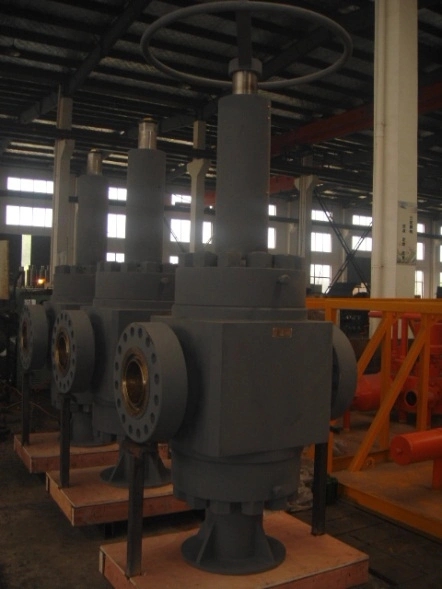
Selecting a wellhead gate valve starts with matching foundational dimensions to your specific wellbore parameters. Small miscalculations here often lead to severe operational bottlenecks.
API 6A standardizes nominal sizes to ensure global compatibility. These sizes typically range from 1-13/16 inches up to 7-1/16 inches. The standard also defines strict pressure classes. These classes start at 2,000 psi and extend up to 20,000+ psi for ultra-deepwater or high-pressure applications.
Decision Rule: Always design your equipment stack for the maximum anticipated wellhead shut-in pressure. You must also factor in potential stimulation pressures. Hydraulic fracturing (frac) operations push extreme pressures through the valve during intervention work. Designing for the absolute peak pressure prevents catastrophic blowouts.
Temperature impacts metal expansion and seal integrity. API 6A maps specific temperature classes to operational environments. Environments range from -50°F arctic conditions to 350°F+ high-temperature applications.
API 6A Temp Class | Operating Range (°F) | Operating Range (°C) | Typical Application |
|---|---|---|---|
K | -75 to 180 | -60 to 82 | Extreme Arctic Service |
L | -50 to 180 | -46 to 82 | Standard Arctic Service |
P | -20 to 180 | -29 to 82 | General Winter Conditions |
S | 0 to 140 | -18 to 60 | Standard Surface Environments |
U | 0 to 250 | -18 to 121 | Moderate Heated Service |
V | 35 to 250 | 2 to 121 | Standard Subsea / Warm Surface |
X | 0 to 350 | -18 to 180 | High-Temperature Operations |
Risk Note: Extreme temperature fluctuations severely degrade elastomeric seals. Rapid cooling and heating cycles destroy non-metallic materials. This degradation necessitates specific metal-to-metal seal evaluations for critical high-temperature wells. Always verify metal seal performance limits.
The internal mechanism dictates how the valve achieves a reliable seal. Engineers generally choose between two primary architectures based on fluid properties and isolation requirements.
A slab gate uses a single-piece gate mechanism. It relies on upstream line pressure to force the gate against the downstream seat. This creates a tight seal.
Best For: These valves handle abrasive fluids exceptionally well. They dominate high-debris environments. Operators prefer slab gates for standard wellhead flow control. They prioritize mechanical simplicity and ease of maintenance. The solid gate slices through sand and particulate matter without jamming.
An expanding gate utilizes a two-piece gate design. The mechanism mechanically expands against both the upstream and downstream seats simultaneously. This action creates a positive, tight seal regardless of internal line pressure.
Best For: This architecture excels in low-pressure sealing scenarios. It performs perfectly in manifold applications. Operators mandate expanding gates for scenarios strictly requiring mechanical double block-and-bleed capabilities. The positive expansion ensures zero leakage even at near-zero line pressures.
Feature | Slab Gate Valve | Expanding Gate Valve |
|---|---|---|
Gate Design | Single-piece solid slab | Two-piece expanding wedge |
Sealing Mechanism | Line pressure-assisted | Mechanically forced expansion |
Low-Pressure Seal | Moderate | Excellent |
Debris Tolerance | High (slices through sand) | Low (debris can jam mechanism) |
Double Block-and-Bleed | No | Yes |
Structural integrity depends entirely on the manufacturing method and base metallurgy. You must scrutinize the body material to prevent catastrophic blowouts.
Evaluating the construction method forms the baseline of any procurement decision. A forged steel gate valve provides unmatched durability. Forged bodies, such as AISI 4130 steel, offer superior structural integrity. They feature a significantly tighter grain structure compared to castings.
Forging eliminates internal voids completely. This provides zero risk of porosity. Cast bodies occasionally hide microscopic air pockets inside the metal walls. These pockets create weak points. Therefore, forged bodies remain mandatory for high-pressure wellhead environments exceeding 10,000 psi. We never recommend cast bodies for critical gas wells.
API 6A categorizes base metals into specific material classes. You must match these classes directly to your anticipated wellbore fluid chemistry.
Standard Service (AA, BB, CC): These classes handle sweet service environments. They present a low corrosion risk. They work perfectly for standard crude oil and benign water injection wells.
Sour Service (DD, EE, FF, HH): These upper-tier classes handle highly corrosive environments containing H2S and CO2. They mandate strict adherence to NACE MR0175/ISO 15156 guidelines.
Implementation Risk: Substituting lower-tier materials in H2S environments invites disaster. Hydrogen sulfide attacks non-compliant metals aggressively. This attack leads directly to sulfide stress cracking. The valve body can literally shatter under pressure without warning. Always demand NACE-compliant documentation for sour service fields.
Internal components endure the harshest conditions. Managing their wear directly extends the overall lifespan of the equipment.
The trim includes the gate, seats, and stem. You must assess the necessity of applying hard-facing overlays to these parts. Tungsten Carbide or Stellite overlays provide critical defense mechanisms. They resist high-velocity erosive wear.
When sand or frac proppant flows through the bore, it acts like a sandblaster. Unprotected steel washes out in hours. Hard-faced trims withstand this aggressive abrasion. They keep the sealing faces intact during heavy intervention work.
Many operators mistakenly believe modern valves are maintenance-free. We must dispel the myth of a "maintenance-free" API 6A valve. Routine lubrication remains an absolute operational requirement.
API guidelines outline strict routine greasing requirements. Operators must follow body cavity lubrication schedules diligently. Injecting heavy-duty grease flushes harmful debris out of the seat pockets. It also maintains metal-to-metal seal integrity. Proper lubrication prevents mechanical galling between the gate and seats. Neglecting this maintenance inevitably causes the valve to seize in the open or closed position.
Purchasing high-pressure equipment demands strict vendor audits. You must verify their quality control processes before signing purchase orders. Ensure they supply reliable petroleum machinery parts.
API 6A defines Product Specification Levels to dictate the severity of quality control. PSL levels govern the extent of required metallurgical testing.
PSL 1 and 2: Suitable for standard, low-risk environments. They require basic material traceability and standard hydrostatic testing.
PSL 3 and 4: Require advanced volumetric non-destructive examination (NDE). Manufacturers must perform rigorous Charpy V-notch testing.
Shortlisting Logic: You must match the PSL to your operational risk level. Choosing PSL 3 or 4 is completely non-negotiable for offshore platforms or high-pressure gas wells. The extra testing guarantees zero hidden material defects.
Performance Requirements validate the engineering design through physical testing.
PR 1: Involves standard cycle testing at room temperature. It validates basic mechanical functionality.
PR 2: Involves severe environmental testing. The manufacturer cycles the valve under extreme temperature and pressure limits simultaneously. This proves the seals will hold during real-world field fluctuations.
Do not accept verbal promises from suppliers. Demand physical documentation.
Demand verifiable Material Test Reports (MTRs) for all pressure-containing components.
Request original hydro-test charts displaying pressure holding times.
Verify the manufacturer holds an active, up-to-date API Monogram license.
Confirm third-party inspection reports for PSL 3 and PSL 4 orders.
Selecting an API 6A valve requires moving far beyond basic physical dimensions. You must rigorously match the internal fluid chemistry, wellbore pressure dynamics, and external operating environment to strict API material and testing classes. Overlooking NACE compliance or underestimating temperature fluctuations compromises site safety.
To ensure successful procurement and field integration, follow these next steps:
Compile precise operational data, including maximum shut-in pressure, extreme temperature ranges, and complete fluid composition.
Determine the necessary PSL and PR levels based on site risk and offshore regulations.
Request a detailed, standard-compliant technical proposal from qualified manufacturers.
Ensure the proposal explicitly includes MTRs, NDE reports, and comprehensive General Arrangement (GA) drawings.
Establish a strict maintenance schedule for lubrication upon installation.
A: API 6A is strictly for wellhead and christmas tree equipment. It handles raw, high-pressure, abrasive wellbore fluids directly at the wellsite. API 6D is designed for downstream pipeline applications where fluids are already processed, clean, and pressures are generally much lower.
A: Forged steel is heavily recommended—and often required—for pressure ratings of 10,000 psi and above. You should also mandate it in highly critical sour service. Forged steel lacks internal voids and provides superior fatigue resistance compared to castings.
A: It indicates that the valve's metallurgy, including the body, bonnet, and wetted trim components, is specifically manufactured and heat-treated. This strict heat treatment allows the metal to resist Sulfide Stress Cracking (SSC) in environments containing highly toxic Hydrogen Sulfide (H2S).
A: Frequency depends entirely on actuation cycles and fluid abrasiveness. Adherence to API guidelines requires establishing a preventive maintenance schedule. You must use OEM-approved, specific gravity lubricants to properly flush out debris and protect the internal sealing faces from galling.