 English



Views: 0 Author: Site Editor Publish Time: 19-08-2026 Origin: Site


An excavator quick coupler represents much more than a simple convenience tool on the job site. It acts as a critical load-bearing component. When coupler materials fail, you face catastrophic safety risks. Unplanned project downtime inevitably follows. Modern quick couplers undoubtedly maximize machine versatility. They allow operators to swap buckets, hammers, and rippers in seconds. However, a massive influx of generic attachments has flooded the current market. This saturation makes rigorous material verification essential for procurement teams.
Choosing the right coupler demands significant attention to detail. You must move beyond basic compatibility checks. Technical teams need to evaluate material yield strength thoroughly. You must also scrutinize specific casting methods. Finally, you need to verify locking mechanism integrity before finalizing any purchase. Proper material specifications prevent dropped loads. They also maintain optimal breakout force. By understanding these core engineering metrics, you protect your crew and ensure seamless operations.
Material composition directly dictates a coupler's lifespan, weight penalty, and safety rating.
Cast steel couplers offer superior stress distribution compared to traditional welded plate designs.
A reliable attachment locking system must integrate high-tensile wear surfaces and redundant safety valves.
Evaluating construction machinery parts at the procurement stage requires demanding verifiable material certificates and compliance with international safety standards (e.g., ISO 13031, NIOSH guidelines).
Procuring low-grade components introduces severe hidden costs to your operation. When you invest in subpar couplers, premature wear happens rapidly. Operators often notice hairline cracking under intense torsional stress. Hydraulic failures become a frequent reality. These issues compound quickly. A minor hydraulic weep can escalate into a complete system blowout mid-lift. When you replace failed parts constantly, your operational efficiency plummets.
We must also address the severe safety and compliance risks. Material fatigue directly causes dropped attachments. Imagine a heavy demolition shear detaching unexpectedly. The resulting liability is massive. Regulatory bodies strictly investigate these incidents. They look for evidence of neglected material degradation. Integrating reliable Construction Machinery Parts mitigates these precise regulatory vulnerabilities.
A successful coupler investment requires meeting strict performance criteria. First, you must minimize breakout force loss. Every inch you add to the tip radius reduces the machine's digging power. Second, you must achieve maximum structural rigidity. The coupler body must withstand immense rotational forces without flexing. If a coupler flexes, the internal locking pins bind. Finding the perfect balance between a low-profile design and rigid material strength defines a successful procurement strategy.
Many contractors mistakenly prioritize initial purchase price over material yield strength. They assume all steel performs similarly under load. This assumption proves dangerously incorrect. Avoid purchasing units lacking verifiable heat treatment logs. Never ignore early warning signs like elongated pin holes.
Historically, manufacturers relied heavily on welded plate couplers. We call this the legacy approach. Welded designs assemble multiple cut steel plates into a single unit. However, high-load applications expose the fundamental weakness of this method. Weld-seam fatigue occurs frequently. The heat-affected zones near the welds create stress concentrations. When an operator pries a stubborn boulder, these stress points bear the brunt of the force. Over time, micro-fractures develop. Welded designs still hold value in specific scenarios. They work adequately for light-duty tasks. You will also see them commonly on compact equipment where extreme torsional loads remain rare.
For heavy-duty applications, the cast steel coupler advantage becomes undeniable. Engineers pour molten steel into a single mold. This creates a monolithic cast design. The engineering benefits are substantial. First, casting eliminates weak weld points entirely. Stress distributes evenly across the entire solid structure. Second, manufacturers can add material thickness only where necessary. This optimizes the power-to-weight ratio perfectly. You get heavier reinforcement around the pin grabs and a lighter frame elsewhere.
When evaluating cast options, look for specific material metrics. Demand high yield strength steel. Ensure the manufacturer specifies excellent abrasion resistance. You also want localized hardening in high-wear zones. The lifting eye and pin contact points must undergo specialized induction hardening.
We must also consider the tradeoff between weight and breakout force. A heavy coupler robs your excavator of vital lifting capacity. Superior cast materials solve this problem. They allow engineers to create lighter, stronger profiles. A lighter coupler keeps your machine nimble. It ensures your breakout force remains incredibly close to the factory specifications.
Table 1: Structural Comparison of Coupler Manufacturing Methods
Feature | Welded Plate Assemblies | Monolithic Cast Steel |
|---|---|---|
Stress Distribution | Concentrated at weld seams | Evenly distributed across body |
Power-to-Weight Ratio | Generally heavier for same strength | Highly optimized and lighter |
Fatigue Resistance | Moderate (prone to micro-cracking) | Excellent (no heat-affected zones) |
Best Application | Compact and light-duty equipment | Heavy civil, mining, and demolition |
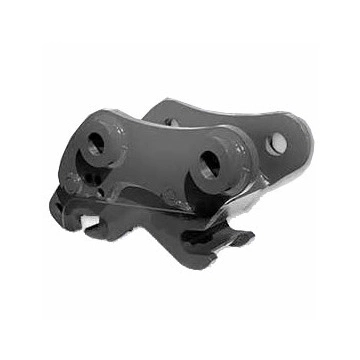
Securing heavy tools requires a flawlessly engineered mechanism. A reliable attachment locking system dictates whether a heavy bucket stays safely attached or plummets into a trench. You cannot compromise on wear surface integrity. The internal pins, moving hooks, and locking wedges endure brutal friction. Standard steel will deform quickly here. Instead, these specific components require induction-hardened steel. Induction hardening creates a tough, wear-resistant outer layer while maintaining a ductile core. This combination prevents the wedges from shattering under impact loads.
Actuation methods also demand careful material consideration. We see both hydraulic and mechanical actuation in the field. Objectively, mechanical locking bars require manual insertion. They rely on simple, robust steel bars. Maintenance remains low, but human error risks remain high. Conversely, hydraulic cylinders offer seamless cab-operated changes. However, hydraulic setups demand higher material standards. The cylinder rods must resist corrosion and pitting. The hydraulic seals must withstand massive pressure spikes when the excavator quick coupler violently shakes during rock breaking.
Hydraulic systems absolutely require built-in redundancy. You must mandate integrated pilot-operated check valves (POCVs). If a hydraulic hose bursts suddenly, system pressure vanishes. A POCV instantly traps the remaining fluid inside the cylinder. This action keeps the locking wedges firmly engaged. Furthermore, modern safety standards demand secondary mechanical locks. These redundant springs or gravity-fed latches provide a physical fail-safe. If hydraulic pressure drops, the secondary lock physically blocks the attachment from releasing.
Grease all designated lubrication points daily to prevent pin galling.
Inspect the pilot-operated check valve weekly for microscopic fluid leaks.
Verify that the secondary mechanical safety latch moves freely without binding.
Never operate the locking cylinder if you hear audible bypassing of hydraulic fluid.
Integrating a new coupler requires strict adherence to load capacities. You must interpret the manufacturer's load charts accurately. Never assume a coupler fits just because the pins align. You must verify the material rating. The coupler's rated lifting capacity must match or exceed the host machine's maximum breakout force. If your 30-ton excavator produces massive pry-out force, a lighter-rated coupler will eventually warp.
Regulatory alignment shapes modern job sites. Safety standards evolve constantly. We strongly advise aligning your material choices with these strict regulations. For example, the National Institute for Occupational Safety and Health (NIOSH) publishes clear safety guidelines for construction and demolition environments. They specifically target unexpected attachment releases. Modern ISO 13031 standards also dictate specific latching requirements. Purchasing components that clearly document compliance with these frameworks protects your workers. It also shields your company from severe legal liability.
Implementation presents its own unique friction points. Adopting new equipment is rarely seamless. You must actively manage several known implementation risks.
Hydraulic Pressure Matching: The carrier machine's auxiliary pressure must match the coupler's cylinder rating. Excessive pressure blows seals. Inadequate pressure fails to drive the locking wedge home.
Installation Errors: Field mechanics sometimes route hydraulic hoses improperly. Rubbing hoses lead to premature ruptures. Proper hose routing brackets are essential.
Operator Training Requirements: Operators must understand the specific visual indicators of a locked coupler. A green indicator rod must be visible from the cab before lifting begins.
Torque Specifications: Mounting bolts require exact torque settings. Over-tightening causes bolt stretch. Under-tightening allows dangerous sheer forces to develop.
Sourcing high-quality parts requires a systematic vetting framework. You cannot rely on marketing brochures alone. When evaluating construction equipment parts, you must demand hard evidence of material quality. Supplier vetting serves as your first line of defense against catastrophic failures.
Start by requesting comprehensive material certificates. Reputable manufacturers gladly provide mill test reports showing exact steel composition. Next, ask for heat treatment logs. These documents prove the pins and wear surfaces achieved the correct hardness depth. Finally, scrutinize the warranty conditions. A warranty covering structural cracking for at least two years indicates manufacturer confidence.
Compatibility audits represent the next critical step. You must ensure the new unit maintains correct pin-to-pin distances. Kinematics matter deeply. If the pin spread changes, the bucket curling geometry alters. Poor kinematics cause buckets to spill material over the cab. Measure the stick width, pin diameter, and pin spread of your specific fleet meticulously. Cross-reference these dimensions with the supplier's engineering drawings.
Actionable next steps involve direct technical discussions with vendors. Do not accept vague terminology. When a vendor claims they use "high-strength steel," ask them for the specific grade. Ask if they use Hardox, Strenx, or equivalent certified materials. Demand cross-sectional drawings showing exactly where they apply induction hardening. Clear, demanding questions quickly separate premium manufacturers from generic importers.
Request ISO 9001 manufacturing certification documents.
Verify availability of localized replacement parts (pins, springs, hydraulic seals).
Confirm the presence of independent third-party destructive testing results.
Audit the manufacturer's technical support responsiveness during the quoting phase.
Material specifications stand as your ultimate defense against equipment failure. Excavator attachments handle immense, punishing loads daily. When you understand yield strengths, casting techniques, and hardening processes, you make vastly superior procurement decisions. Relying on basic visual inspections simply invites disaster onto your job site.
We strongly advise decision-makers to prioritize monolithic cast designs over welded plates for all heavy-duty applications. The superior stress distribution and optimized weight ratios deliver unmatched reliability. Furthermore, you must insist on completely transparent safety mechanism specifications. Redundant check valves and secondary mechanical locks are non-negotiable requirements.
Take immediate action today. Encourage your maintenance team to audit your current fleet's couplers. Look for stress fractures and worn locking pins. If you notice degrading components, contact a qualified attachment specialist immediately to review your specific fleet compatibility and upgrade your hardware.
A: Lifespan depends heavily on material choices and operating hours. Cast steel couplers generally outlast welded plate designs. A well-maintained cast unit can exceed 5,000 to 7,000 operating hours. Conversely, welded units in heavy-duty applications may show fatigue cracking near weld seams around 3,000 hours. Regular greasing significantly extends both lifespans.
A: Yes, it inherently reduces breakout force by extending the tip radius. However, you can mitigate this loss effectively. Choosing low-profile designs built from high-strength cast steel minimizes the extra length. Superior kinematics ensure your bucket curl remains tight, preserving maximum digging power.
A: Yes, provided you use a multi-pin or pin-grabber system. These specific designs accommodate varying pin spreads. However, you must meticulously check OEM tolerances. The attachment's pin diameters and stick width must fall within the coupler's rated structural limits to prevent dangerous internal binding.
A: Visible indicators require immediate attention. Look for hairline cracks propagating near weld zones or lifting eyes. Watch for elongated or oval-shaped pin holes. Excessive side-to-side play indicates severe internal wear. Finally, hydraulic fluid weeping from the locking cylinder suggests intense pressure spikes have compromised the internal seals.